Why legal AI fails
Ask a general-purpose assistant a question about EU regulation and you will usually get a fluent, confident, well-structured answer. That is the problem. The answer reads exactly the same whether the underlying provision is quoted correctly, quoted from a version that was amended two years ago, or invented outright. The failure is invisible at the moment you most need it to be visible.
For a compliance professional that is not a nuisance — it is disqualifying. You are not looking for a plausible paragraph. You are looking for something that survives a reviewer, a regulator or an audit. Here are the five ways legal AI actually fails, and what has to be true of a tool for those failures to go away.
1. It invents article numbers
A language model generates the most likely next token, not the true one. Citations are exactly where that breaks: an article number is short, arbitrary and looks like thousands of other article numbers in the training data. So the model produces one that fits the shape of the answer. It is not lying — it has no mechanism to distinguish a citation it has seen from one it has assembled.
The tell-tale sign: the reasoning around the citation is often broadly right, which is what makes the wrong number so easy to accept.
2. It quotes law that has since changed
EU law is not static text. An act is amended, corrected and consolidated; what is binding today is the current consolidated version, not the original publication. A model trained on a snapshot of the web has absorbed all of them at once — the original, the amendments, and every blog post describing both — with no reliable way to tell you which one it just used, or on what date that was true.
3. It cites law that no longer applies
Provisions get repealed. Proposals get withdrawn before ever becoming law, yet they generated years of commentary that reads exactly like commentary on law in force. Obligations have staggered application dates, so a provision can be simultaneously “in force” and “not yet applicable” — a distinction that decides whether you have a problem today or in eighteen months. Models routinely flatten all of this.
4. It blends the source with its own opinion
Most assistants hand you one block of prose in which the words of the legislator and the model's gloss on them are typographically identical. Even when both are correct, you cannot tell where the law stops and the interpretation starts — so you have to go and read the source anyway, and the tool has saved you nothing.
5. It gives you nothing you can defend
This is the one that matters. An answer with no traceable source cannot go into a deliverable, a DPIA, a board memo or a regulator's inbox. If the only provenance is “the AI said so”, then in any review that counts, you have nothing. The work of verifying the answer by hand is the work you were trying to avoid.
What has to be true instead
Every one of those failures has the same root cause: the model is allowed to write the law. Remove that, and they all go away at once. That is the design decision Acquis is built on.
The model never types the law
The verbatim provision is rendered from a signed corpus built from the official EUR-Lex source. The model's only job is to choose which provisions are relevant and explain them. It cannot invent an article number, because it never writes one.
The current consolidation, dated
Daily sweeps of the official EUR-Lex/CELLAR catalog pick up new consolidations, corrigenda and status changes. Every answer carries the consolidation date and in-force status — and the previous versions stay queryable, with their validity windows.
Source and reading, separated
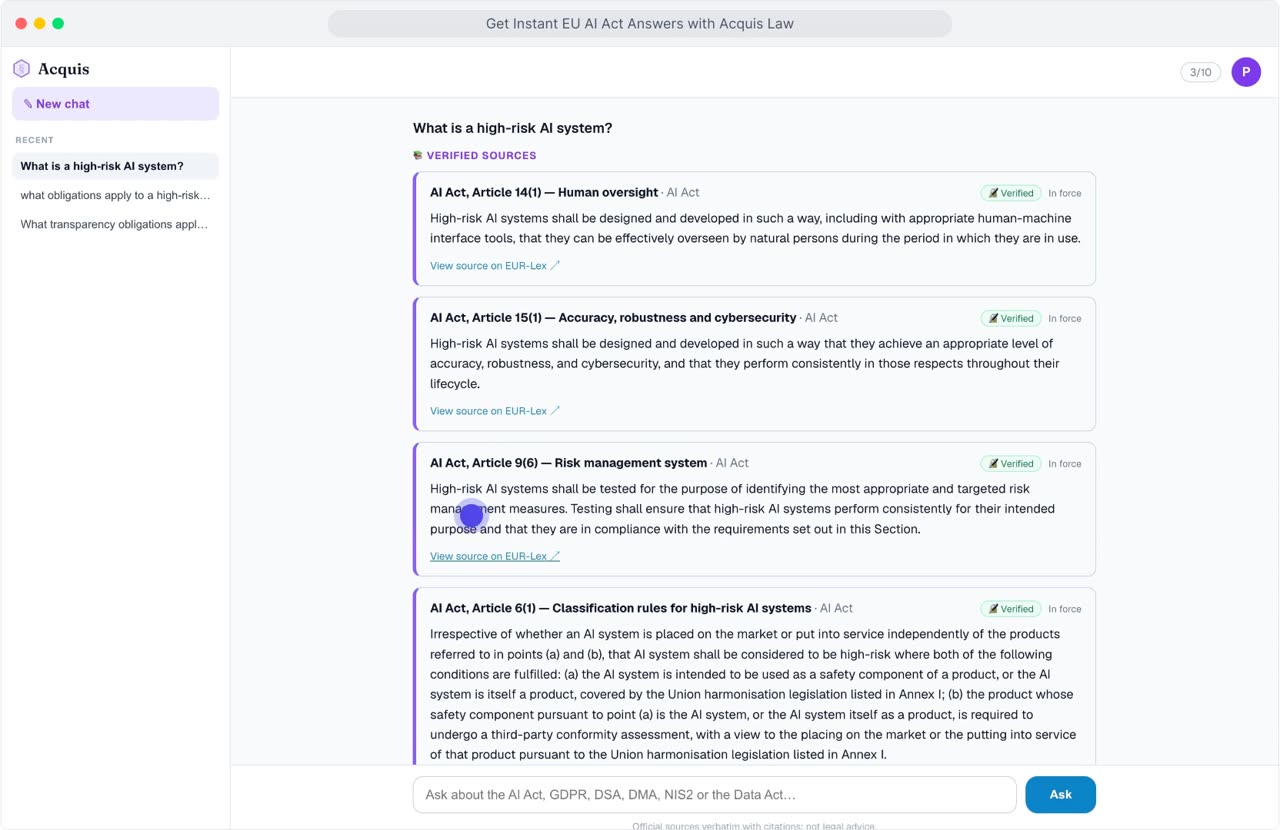
The verbatim text and the plain-language interpretation are rendered as two visually distinct zones. You always know which words are the legislator's and which are the model's.
Provenance you can hand to a reviewer
Every fragment carries its exact citation (act, article, paragraph, point), a deep link to EUR-Lex, and a cryptographic check: it is content-hashed and signed at ingestion, so any quote can be verified against the official source rather than trusted.
What that looks like
One question — “What is a high-risk AI system?” — answered with four provisions of the AI Act. Each one is the legislator's own wording, tagged with its citation and in-force status, and each one links to its source on EUR-Lex. Nothing here is a summary.
Acquis covers the EU digital rulebook — see the live coverage page for exactly what is indexed today and what is on the way. Prefer to work inside your own assistant? Connect it to Claude, ChatGPT or VS Code.
Acquis returns official sources verbatim with citations; it is not legal advice. Texts © European Union, reuse permitted (Decision 2011/833/EU). Powered by HIVE.